The aim of this protocol is to take coral fragments that have been snap-frozen in liquid nitrogen and extract both DNA for downstream archaea & bacteria microbiome 16S Microbiome Sequencing and RNA for downstream coral-host tissue Tag-seq or RNA-seq analysis.
In plain, I want to answer ‘who is there?’ regarding the bacterial community, and ‘what is the coral doing?’ regarding gene expression.
The benefits of doing DNA and RNA extraction together are that it saves time, money, & sample material. It also facilitates paired sample analysis, where each data point in one dataset is uniquely paired to a data point in the second dataset because we are making duplicate measurements on the same sample.
The challenge is lysing the sample enough to get the bacterial DNA (busting open all those layers of cell membranes!) and retaining host (coral) RNA integrity.
This protocol relies heavily on the Zymo Research Protocol PDF & URI Putnam Lab Emma Strand’s notebook post on ‘Zymo-Duet-RNA-DNA-Extraction-Protocol’, with a few alterations suggested by Zymo tech on March 28th 2023 regarding optimized lysis protocols.
📞Zymo is very responsive to phone calls! Any questions on the kit you can call 888-882-9682 and reference catalog number D7003 to ask technical questions galore.
Advanced Prep
Biological Sample Info
- liquid-nitrogen snap-frozen ~3cm Montipora capitata coral fragments held at -80°C
Background
👀 WATCH ➡️ Bumbling Biochemist ‘Spin column purification of nucleic acids’ on YouTube
👀 WATCH ➡️ Bumbling Biochemist ‘tips for working with DNA/RNA spin columns’ on YouTube
📖 READ ➡️ CAN CORAL DNA MEASURE OCEAN HEALTH? on biolinkk
Materials List
Extraction Kit
Zymo Research Quick-DNA/RNA Miniprep Plus Kit (50 prep D7003, or 10 prep D7003T)1 prep = 1 sample that results in DNA in one tube, and RNA in another includes:
- DNA/RNA Lysis Buffer
- DNA/RNA Prep Buffer
- DNase/RNase-Free Water
- DNase I2 (lyophilized… aka freeze-dried)
- DNA Digestion Buffer
- DNA/RNA Shield (2X concentrate)
- PK Digestion Buffer
- Proteinase K3 (lyophilized… aka freeze-dried)
- Proteinase K3 Storage Buffer
- Spin-Away Filters
- Zymo-Spin IIICG Columns
- Collection Tubes
ZR BashingBead Lysis 2mL Tubes with 0.1 & 0.5mm beads, 1 per prep
DNase/RNase/nuclease-Free Tubes, 3 per prep
DNase/RNase-Free Tubes, 3 per prep
PPE
- nitrile gloves
- liquid-nitrogen & cold storage handling gloves
- lab coats
Lab Equipment
lab mortar & pestle sets
lab label tape
centrifuge
[ ]Beckman Coulter Microfuge 16](https://www.beckman.com/landing/ppc/cent/benchtop/microcentrifuges?utm_source=google&utm_medium=cpc&utm_term=microcentrifuge&gclid=CjwKCAjw586hBhBrEiwAQYEnHYq-F4WNopG5rWYG4Bb0YjPlfXL7pVCESNmTwqyT6Cgxty-Si8AAdhoC8I0QAvD_BwE)
mortexer / homogenizer
Mortexer Vortex Mixer with included Multi-Head to hold 8 microcentrifuge tubes (this is what we have)
…OR…
Vortex Genie 2 with Horizontal Microtube Holder (recommended by Zymo optimized lysis protocols)
liquid-nitrogen (stored in dewer or tank)
small liquid-nitrogen thermos (1L)
small cooler (for dry ice and samples)
##### dry-ice
Biochemistry Store in hallway adjacent to Room J-014, Health Sciences Building
The entrance can be found at the Health Sciences Building loading dock across NE Boat St. from Saint Bread, NE of the Ocean Sciences Building
must have UW Husky Card to fob-activate doors leading from loading dock and interior hall
bring well-insulated foam or hard cooler. First weigh empty cooler, add dry-ice, then weigh again and record final weight, budget#, PI, and name on the clipboard near the dry-ice station
probably best to drive rather than carry a cooler of dry-ice for three blocks
Reagents
- nuclease free (DEPC-treated) autoclaved water
- 95% (190 proof) - 99.5% (200 proof) ethanol
Sterilizing
- 10% bleach in spray-bottle
- 70% ethanol in spray-bottle
- DI water in spray-bottle
- RNase away in spray-bottle
- Kimwipes/paper towels
Pipettes & Tips
- P10 + filtered tips DNase/RNase free
- P100 + filtered tips DNase/RNase free
- P1000 + filtered tips DNase/RNase free
- P5000 + tips (for buffer prep)
Randomize Sample Processing
Make sure to randomize which samples are processed in each batch to reduce ‘batch effects’!
See ‘Randomize Sample Processing’ script as an example.
Think about how many samples you can process at once, and your kit, centrifuge, and homogenizer capacity.
Lab Setup
Sterilize
Don lab coat 🥼 & tie hair back , glove up 🧤
Spray down
benchtop,microcentrifuge tube racks,pipettes, andpipette tip boxeswith:10% bleachin spray-bottle, then wipe with KimwipeDI waterin spray-bottle, then wipe with Kimwipe70% ethanolin spray-bottle, then wipe with Kimwipe
Spray down
mortars & pestles,scoopulas, andforcepswith:10% bleachin spray-bottle, then wipe with KimwipeDI waterin spray-bottle, then wipe with Kimwipe70% ethanolin spray-bottle, then wipe with KimwipeRNase awayin spray-bottle, then wipe with Kimwipe
Spray Kimwipe with
RNase awayand wipe down equipment buttons/handles/surfaces that may have been touched by ungloved handsSpray
RNase awayon gloves and rub hands together
Arrange Lab Bench
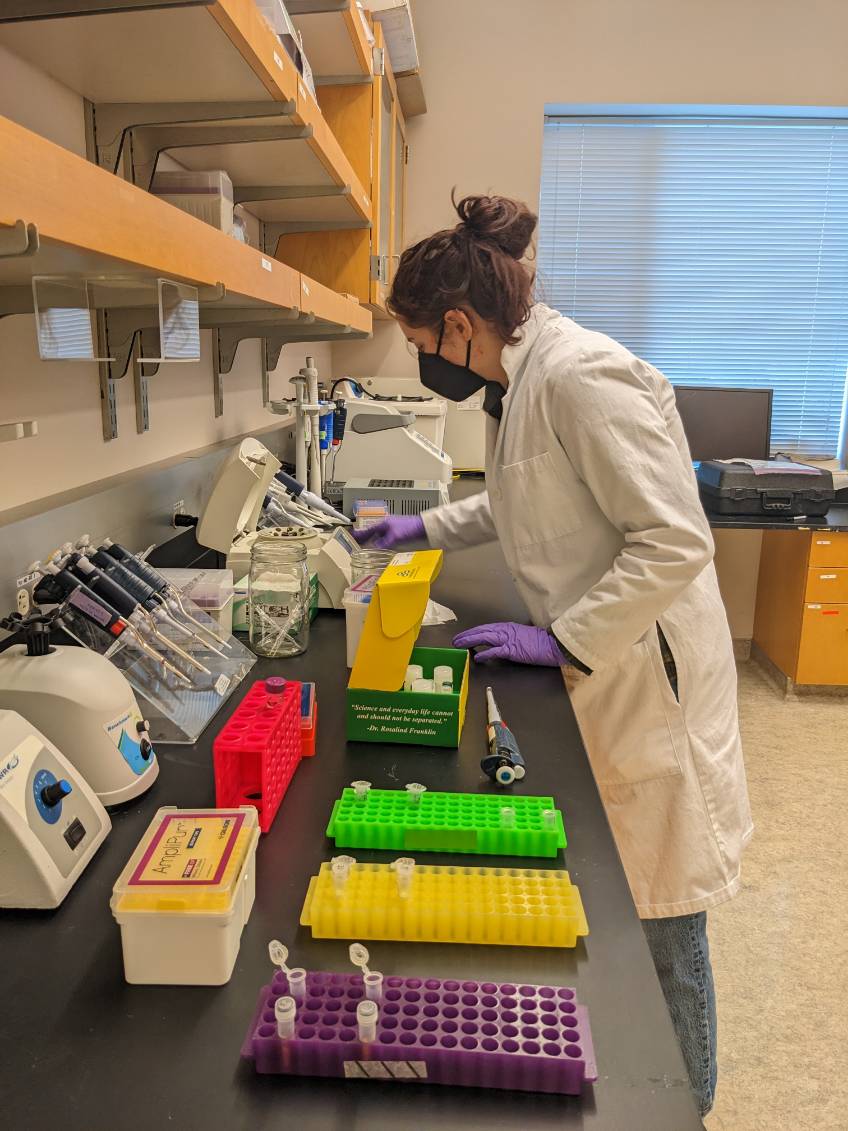
This extraction protocol can be split into two main phases: 1. lysing and 2. purification. I setup the lab bench with each phase occupying a station on the bench, with materials used in each phase arranged accordingly. Make sure you have trash, pipette disposal, and waste disposal containers within easy reach of the workstation.
Lysing Station
liquid nitrogen dewer
dry-ice bucket with samples
mortars & pestles
Mortexer
Purification Station
- centrifuge
- microcentrifuge tube racks
Label Tubes
The samples originate from their 1.5mL cryo-vials, which are labelled with their cryo_id. Since it’s important to keep track of which samples were extracted using the same kit, the same reagents, the same day, etc. for batch effects, I use extraction IDs (extr1, extr2, extr3 , etc.) to label samples that were processed together.
Each sample will need the following 7 tubes labelled:
1 bead-bashing tube,
You can also label an additional qubit tube if you are moving straight from extraction to quantification.
Only thin-wall, clear 0.5 mL PCR tubes are appropriate for use in the Qubit® fluorometer. Acceptable tubes include Qubit® assay tubes (Invitrogen Cat. no. Q32856, 500 tubes) or Axygen PCR-05-C tubes(VWR, part number 10011-830).
The qubit tube should only be labelled on the top; the sides should be clear so that the qubit fluorescence can be read without impedance.
The intermediate tubes and qubit tubes should be labelled with the cryo_id & extraction_id , such as: 1Ea extr1.
The FINAL tubes should be labelled with cryo_id, DNA/RNA, extraction_id, date (ddMMMyy), & initials, such as:
1Ea
RNA
extr1
10APR23
SST⚠️Important Notes! ⚠️
- Use ethanol-proof lab markers to label tubes (ethanol is added to the green spin away collection tube)
- Label collection tubes, not filters!
- Always wear lab gloves that have been sterilized before handling tubes!
- Shake tubes out of their bags onto sterilized surface, don’t ‘reach in’ (this reduces potential contamination)
Prepare Buffers
If using the 50-prep kit (D7003), add
96 ml 100% ethanol (104 ml 95% ethanol)to the 24 ml DNA/RNA Wash Buffer concentrate. If using the 10-prep kit, DNA/RNA Wash Buffer (D7003T) is supplied ready-to-use and does not require the addition of ethanol.
Reconstitute
lyophilized DNase IwithDNase/RNase-Free Waterand mix by gentle inversion. Use immediately or store frozen aliquots.- 50-prep, add 275 µl water
- 10-prep, add 55 µl water
Reconstitute
lyophilized Proteinase Kat 20 mg/ml withProteinase K Storage Bufferand mix by vortexing. Use immediately or store frozen aliquots.- 50-prep, (60 mg), add 3.12 ml buffer
- 10-prep, (5 mg), add 0.26 ml (260 ul) buffer
To prepare a 1X solution of
DNA/RNA Shield™, add an equal volume (5mL for the whole solution) ofnuclease-free water(not provided) to theDNA/RNA Shield™(2X concentrate) (1:1) and mix with a quick pulse on the vortexer.
Extraction Steps
Grind/Homogenize: Mortar & Pestle Samples
Take dry-ice cooler to -80 freezer, pull out frozen samples and place them in the dry-ice cooler. Work quickly and carefully to sort through the vials and select the ones that you are working with. Nest the selected sample vials in the dry ice, and return the rest back to the -80 freezer. Bring working samples on dry-ice back to the lab bench.
Don cryo-gloves over nitrile gloves and ⚠️carefully⚠️ dispense a small amount (no more than 1L) of liquid nitrogen (LN2) into the transfer thermos. Everyone working with LN2 should have taken the Liquid Nitrogen Online Safety Course found HERE
Grind each sample with mortar & pestle on LN2 -
- ⚠️carefully⚠️ pour a small amount of LN2 into a sterilized mortar
- Using sterilized forceps, pluck out coral fragments from the cryo vial and place in the mortar until you have as much material as about the size of an M&M (roughly a 16mm diameter sphere). Material amount does not have to be precise.
- Pestle the coral fragment until it is ground to a powder. Work quickly to ensure the sample remains frozen. Add more LN2 when it evaporates from the mortar. This step is challenging! LN2 evaporates very quickly and must be replenished multiple times.
The coral is also very hard and prone to ‘squirting out’ from under the pestle, so be extra careful while grinding!
Lyse: Bead-Bash Samples
Use sterilized scoopula to transfer the sample powder to its correspondingly labelled bead bashing tube
Aim to transfer 500uL of volume to each tube
Add 500uL of
DNA/RNA Shieldto each 2mL (0.1 - 0.5mm) bead-bashing tube with powdered sample and vortex to ensure powder is submersed inDNA/RNA Shield
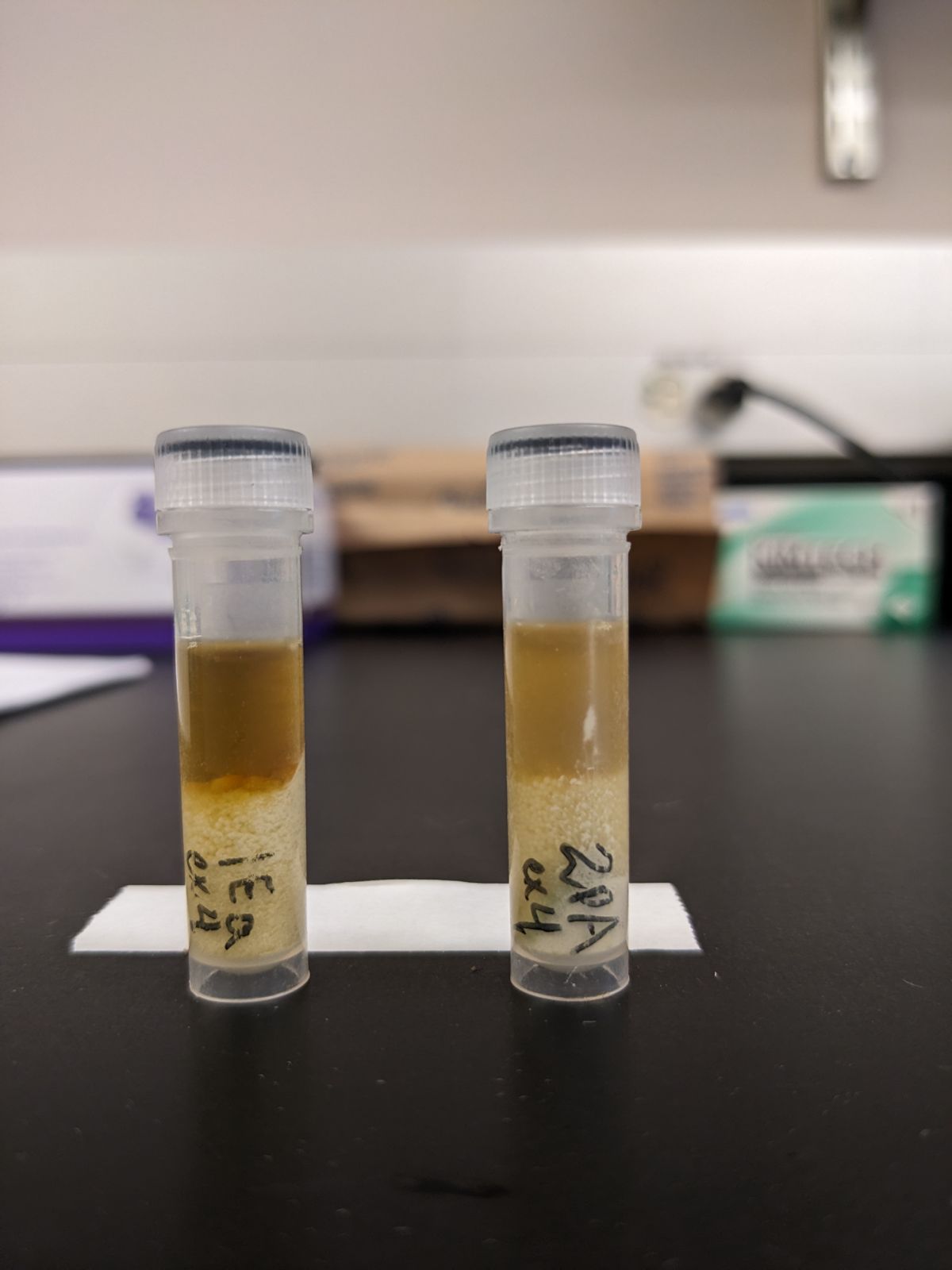
- Set bead-bashing tubes in Mortexer and vortex at high speed for 40 minutes
Proteinase-K Digestion
After bead bashing tubes are ‘intensely bubbly’
To tamp down bubbles, centrifuge in the mini-centrifuge for 1-2 minutes
Add Proteinase K & Buffer
Add the appropriate volume of Pro K buffer and Proteinase K (Proteinase K is stored in the -20 after being reconstituted)
(10:1 ratio of sample:digestion buffer) & (2:1 ratio of digestion buffer:Proteinase K)
For tubes with 500ul add:
- 50ul pro k buffer
- 25ul proteinase K
If you have tubes with a larger volume you can scale up the volumes (ex for 700ul, you would use 70ul buffer and 35ul pro k)
Let incubate at room temperature for 2 hours
Purify DNA & RNA
- Transfer the buffered supernatent (should be a total of 800uL, which can be passed through the filter in one go) to yellow Spin-Away Filter in a Collection Tube and centrifuge
Tranfser the yellow Spin-Away Filter to a new Collection Tube
To the RNA flow-through, add 800uL (1:1) of 200-proof ethanol to the flow-through and mix by pipetting up and down 12 times
In aliquots up to 700uL, transfer the RNA in ethanol to the green Zymo-Spin IIICG Column in a Collection Tube, centrifuge, and discard the flow-through. This step binds the RNA to the green column filter.
DNase 1 Treatment
Add 400uL DNA/RNA Wash Buffer to the green Zymo-Spin IIICG Column, centrifuge and discard the flow-through
To prepare DNase 1 Reaction Mix: \[ DNase\, 1\, volume = 5 \mu L * (no.\, of\, sample\, preps) \]
\[ DNA\, Digestion\, Buffer\, volume = 75 \mu L * (no.\, of\, sample\, preps) \]
- Add 75uL of DNA Digestion Buffer per prep to a new nuclease-free tube
- Add 5uL of reconstituted DNase 1 (thawed if previously frozen at \(-20^{\circ}C\)) per sample prep to the nuclease-free tube
- Mix by gentle inversion
Carefully drip \(80 \mu L\) of DNase 1 Reaction Mix directly onto the green Zymo-Spin IIICG Column filter and let incubate at room temperature for 15mins
Add \(400 \mu L\) DNA/RNA Prep Buffer to each column and centrifuge at 16,000xg for 30s, then discard the flow-through
Add \(700 \mu L\) of DNA/RNA Wash Buffer to each column and centrifuge at 16,000xg for 30s, then discard the flow-through
Add \(400 \mu L\) of DNA/RNA Wash Buffer to each column and centrifuge at 16,000xg for 2mins to ensure complete removal of the wash buffer, then discard the flow-through
Carefully transfer the column into the FINAL nuclease-free tube labelled for containing the eluted DNA/RNA end products
Add \(50 \mu L\) DNase/RNase-Free Water directly to the column matrix and centrifuge at 16,000xg for 30s
Place FINAL eluted DNA/RNA tubes on ice
Transfer \(1 \mu L\) of each eluted DNA/RNA sample to their respectively labelled Qubit assay tube, and place Qubit assay tubes with eluted DNA/RNA on ice
Store FINAL eluted DNA/RNA tubes in wax boxes in the \(-80^{\circ}C\) freezer
Take Qubit assay tubes to run Qubit quantification on eluted DNA and RNA
End Products
The end products are two 1.5mL vials per sample that contain:
- 50ul of DNA in nuclease-free water
- 50ul of RNA in nuclease-free water.
Place these vials on ice and for RNA proceed with Qubit RNA Broad Range Protocol OR, to continue lab-work later,
Place them in a wax freezer box, label the box, and freeze them in the -80C.